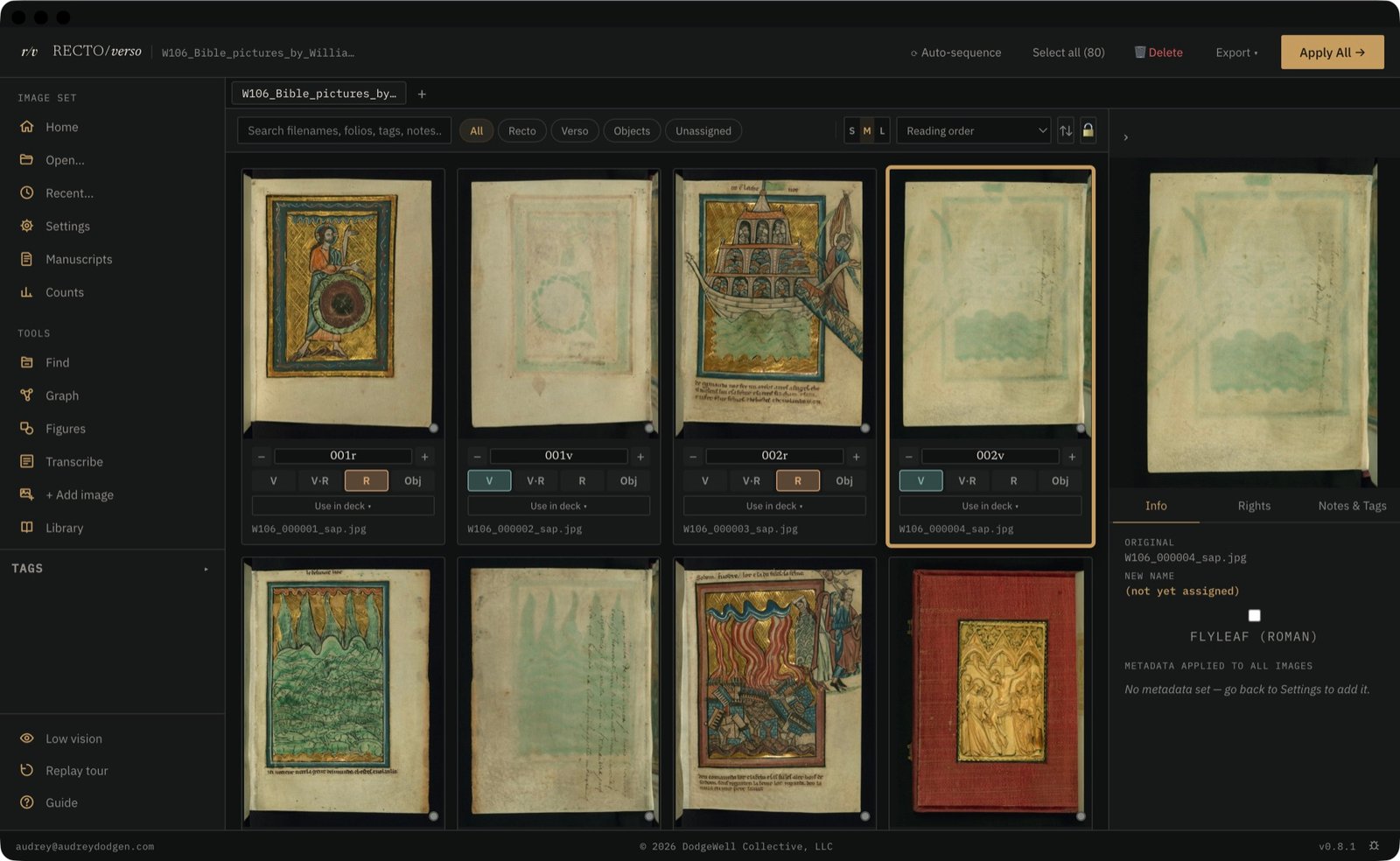
Make the source set legible before you begin interpreting it.
Move from camera filenames to a manuscript you can cite
Archive photographs arrive as a sequence of files. Research needs a sequence of pages, sides, folios, and exceptions. Recto/Verso gives that sequence a place to live, so you can move through a manuscript without guessing which image comes next or where a photograph belongs.
Keep Arabic and Roman foliation side by side.
Attach recto and verso identity to each photograph.
Keep flyleaves, boards, bindings, and exceptional objects in the same source set.
Apply ranges in batches, then make precise overrides where the manuscript requires them.
Keep the context beside the image
Repository, shelfmark or call number, photographer, description, keywords, and rights details are part of the research record. They should be available while you work, not reconstructed from a notebook when it is time to write.
Apply only when you're ready.Recto/Verso previews every proposed filename and flags conflicts before it embeds metadata or renames files. Apply never retouches, recompresses, or crops pixel data.