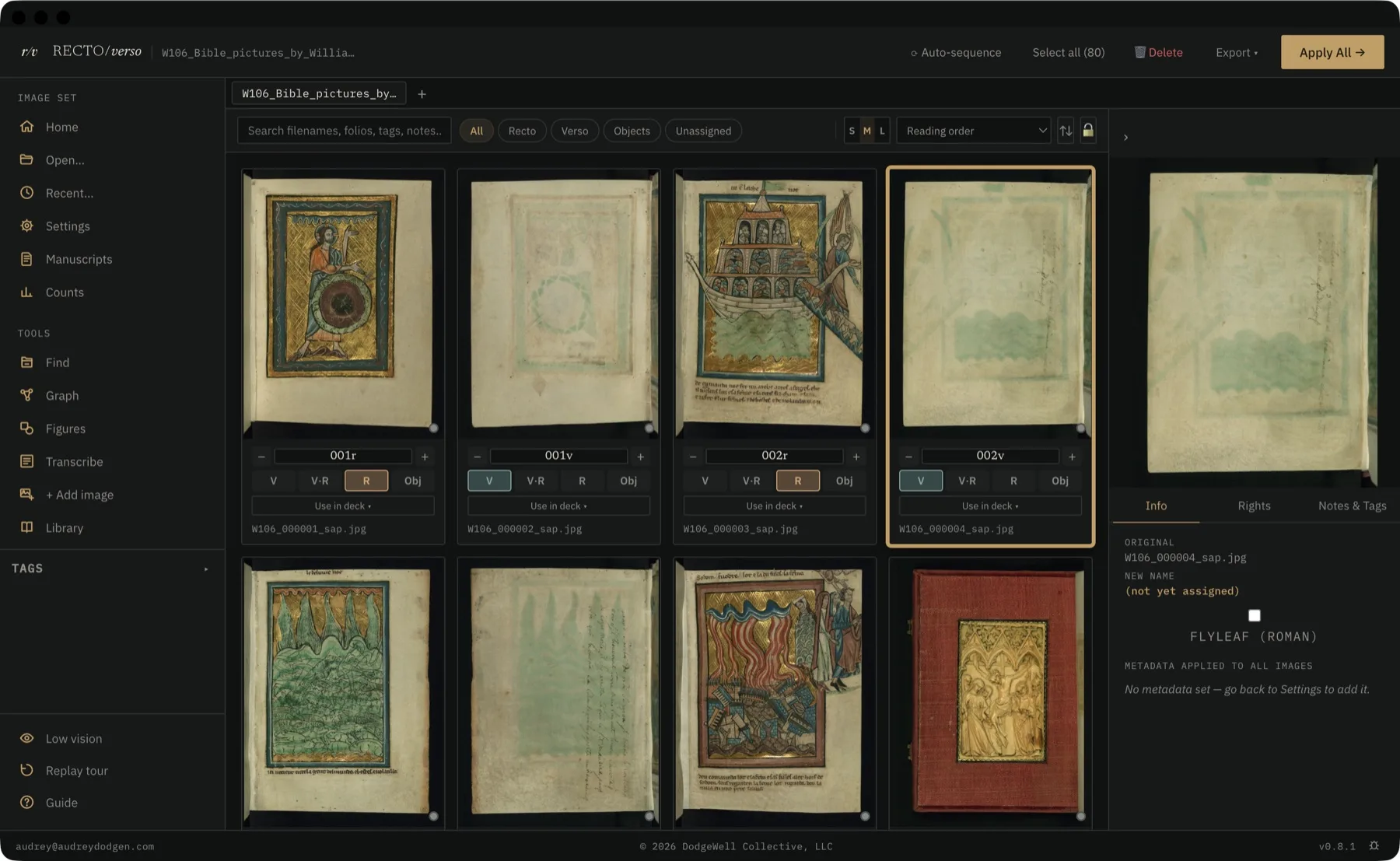
After the archive comes the cataloging: hundreds of photographs still named by the camera, institutional metadata and reproduction rights unrecorded. Recto/Verso renames them to your foliation and writes the shelfmark, photographer, and rights into every file — all in one pass, on your own machine.
v0.7.0 · macOS · Windows
Every historian who photographs manuscripts knows what comes next: three hundred files still named IMG_4471.CR2, the shelfmark and reproduction terms written down nowhere but a notebook. Recto/Verso renames the entire folder to your foliation and embeds the catalog in each file — so MS_Bodley264_012r.jpg already carries its shelfmark, its photographer, and who cleared it for print.
Rename images to your naming convention (MS_Bodley264_001_r.jpg) with a configurable prefix and separator. Switch to roman-numeral flyleaves or printed-book signatures (A1r, B1r) when arabic numbering doesn't match the manuscript. Auto-sequence assigns recto/verso alternating from any starting folio in a single click.
Write institution, shelfmark, photographer, rights, keywords, and description directly into the image files. The information travels with your photographs: open them in any app, share them with colleagues, submit them to a publisher, and it's all there.
Record who granted reproduction rights, the reference number, date granted and expiry, and which arenas are cleared: academic print, academic online, commercial, exhibition, broadcast. Filter your grid by rights status at a glance.
Verso–recto spreads (010v–011r), roman-numeral flyleaves (iv r), and quire signatures (A1r, B1r) sit alongside plain arabic foliation. Shift-click a range, assign a whole quire's sides in one action, filter the grid down to just what's still unassigned.
Levels, gamma, decorrelation stretch, and CLAHE — the tools for pulling faded ink, scraped-off text, and underdrawing out of a photograph, alongside brightness, contrast, and channel isolation. The enhanced version saves as a separate copy the folio keeps; the original file is never touched.
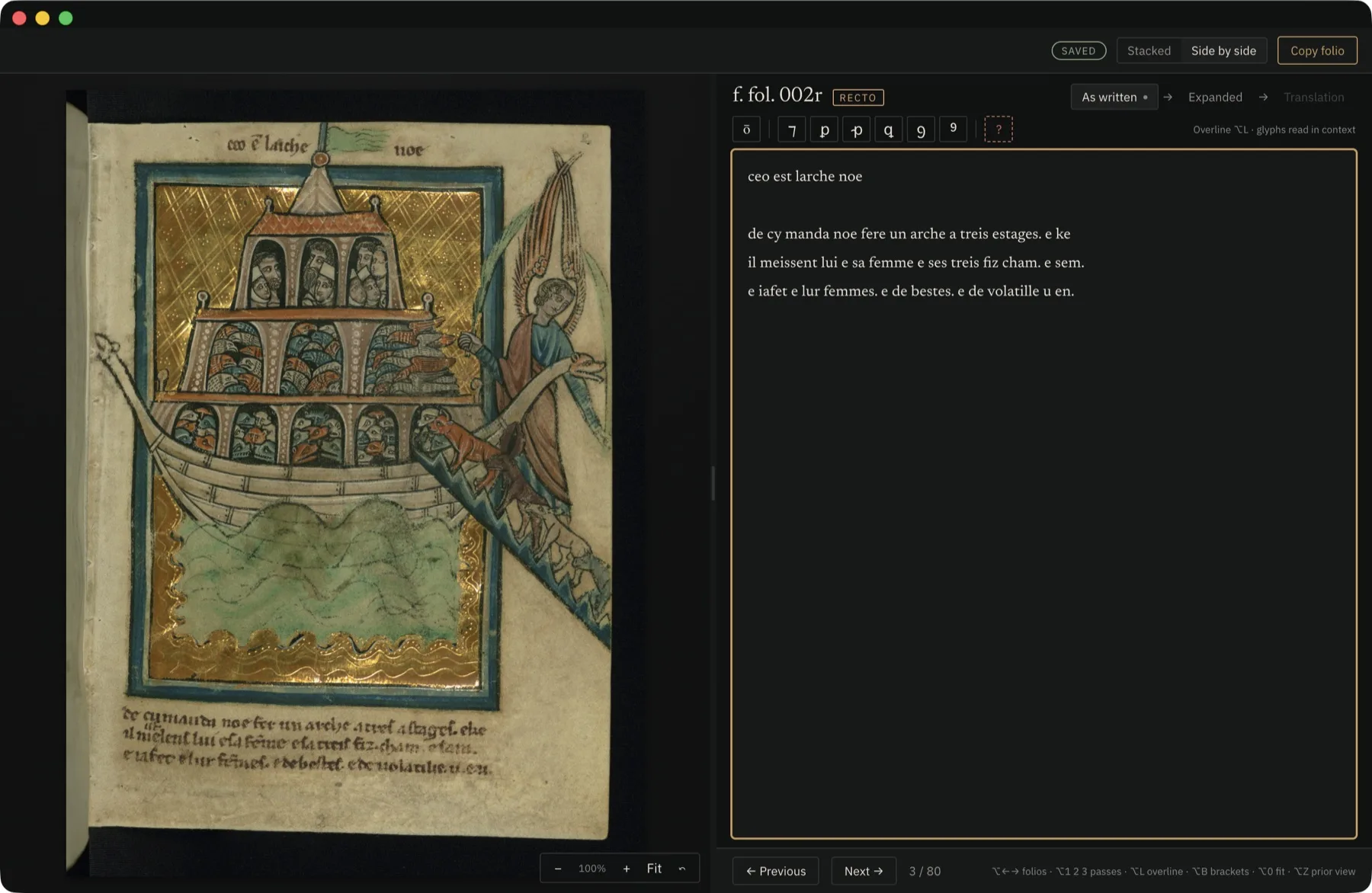
Once the folios are named and described, the same catalog does more than store them.
Draw a box around an initial, a marginal hand, or a damaged patch, and catalog that — with its own label, tags, and note. Export your regions as CSV, plain JSON, or W3C Web Annotation (the format IIIF viewers read).
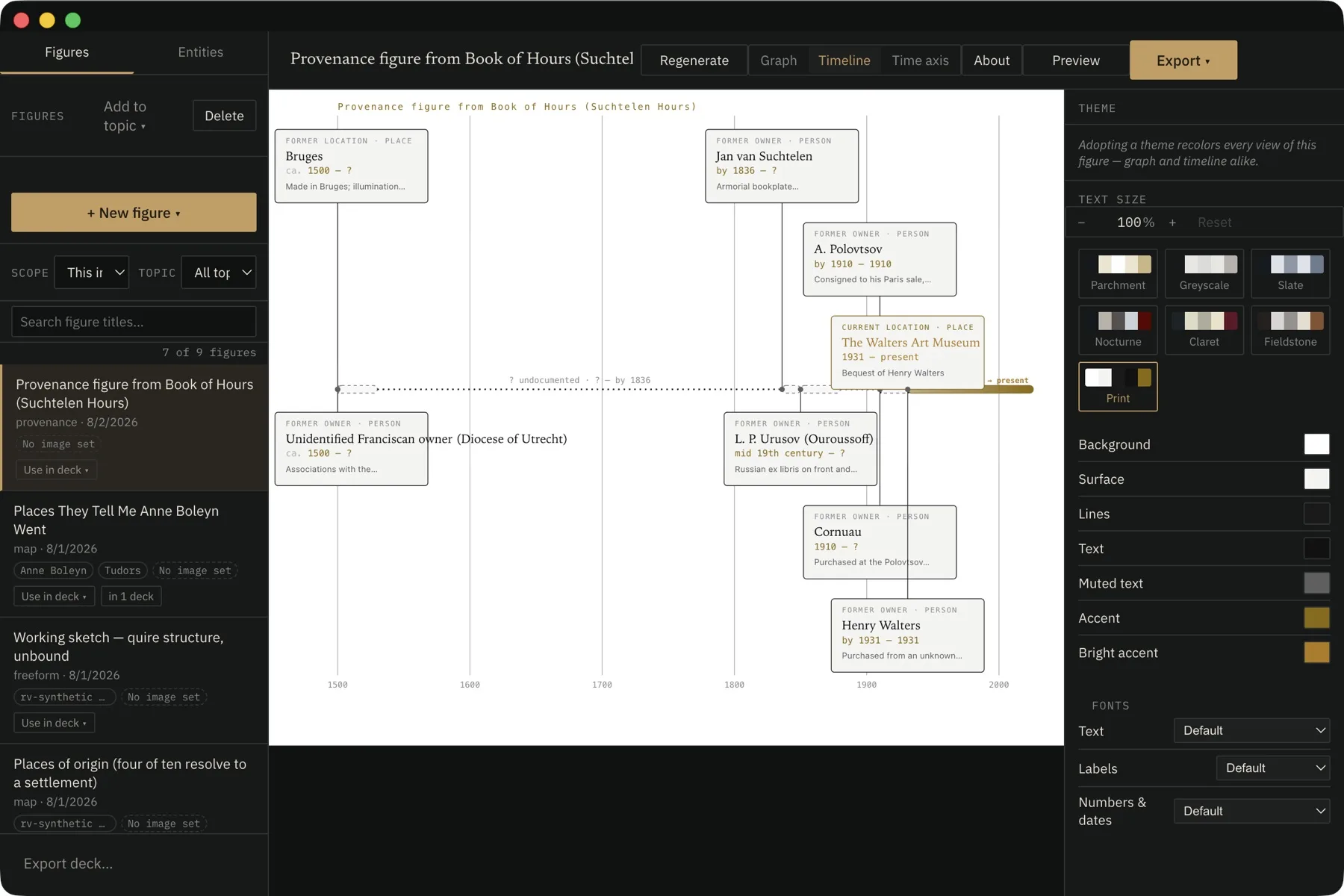
Turn the relationships you've recorded into a figure: a stemma of textual descent, a provenance timeline, an attribution cluster grouping one scribe's hands, a family tree. Export to PNG for the lecture slide or the article plate.
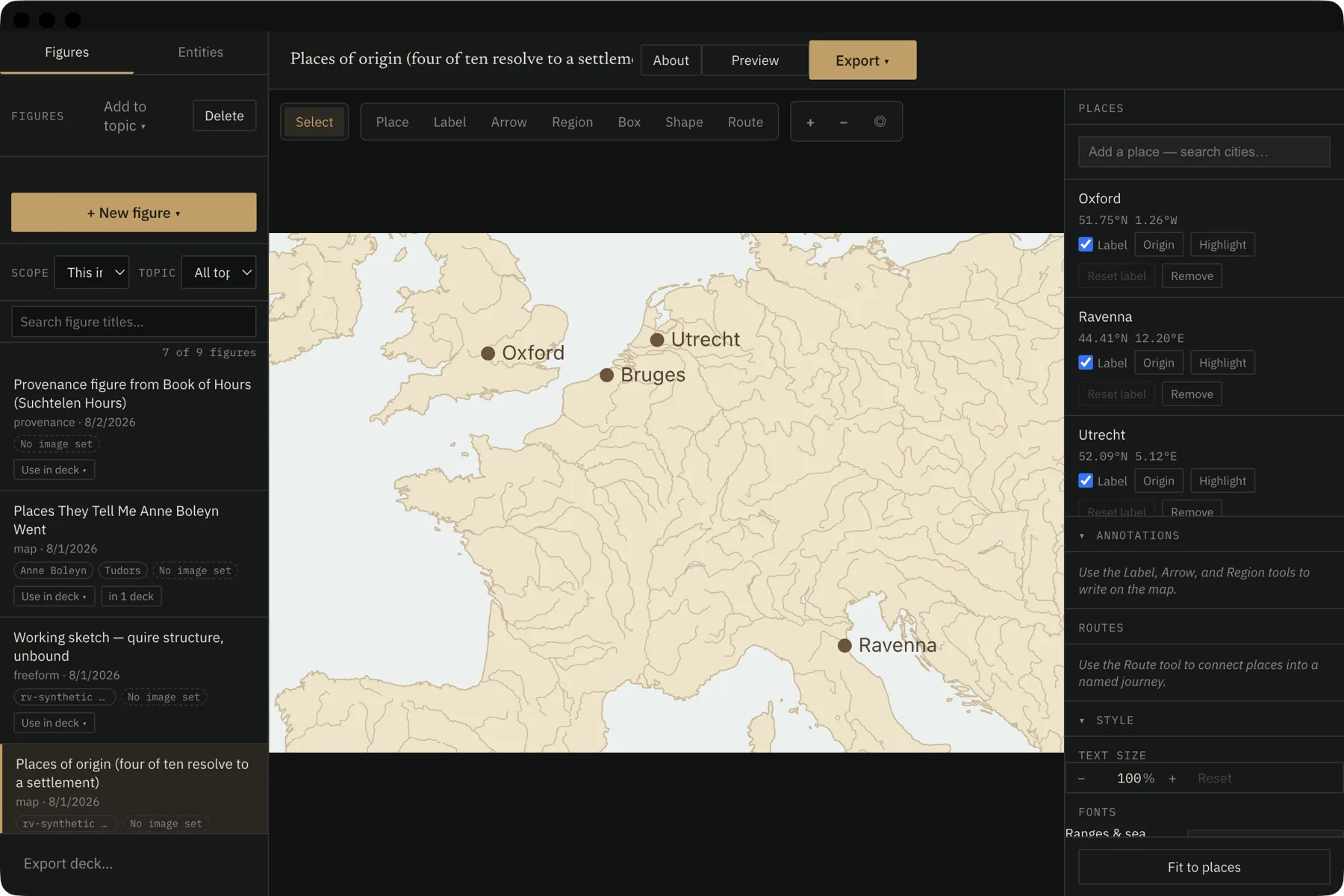
Place folios and sites on a real map — 170,000 towns and cities searchable by name or historical exonym (Bruges finds Brugge). Add pins, labels, arrows, and regions. Fully offline: no tile server, no account, nothing uploaded.
While you're cataloging a folio, link the source that discusses it, with a page locator: Smith 2020, pp. 44–46. Then click any folio to see every source that cites it — and any source to see every folio it discusses, with the page. Pull in your existing Zotero library or add references directly; citations format in Chicago automatically. It ships with every copy, free.
Point Recto/Verso at the folder containing your session's images. Set your project name and default metadata fields once; they save with the project.
Auto-sequence the whole session in one click, or click individual images to assign folio numbers and sides manually. Select multiple images to batch-assign V or R.
Recto/Verso writes the metadata into the files themselves and renames them to your scheme — MS_Bodley264_012r.jpg. Originals are never overwritten, and the renamed, tagged files open correctly in Finder, in any image app, and in a publisher's system.
Recto/Verso is in active beta. Leave your name and email and we'll send you the download link.
macOS and Windows